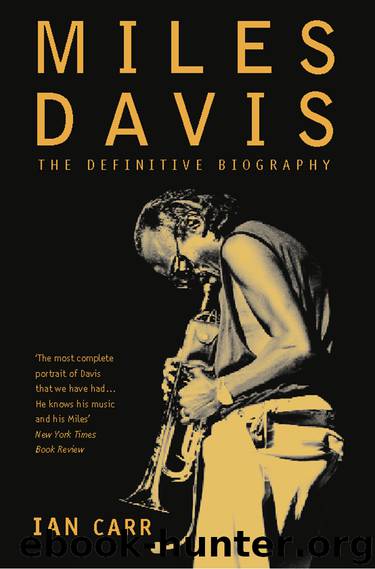
Miles Davis by Ian Carr
Author:Ian Carr [Carr, Ian]
Language: eng
Format: epub
Publisher: HarperCollins Publishers
Published: 1998-01-30T05:00:00+00:00
EIGHTEEN
The Silent Years, 1976–1980
‘Sex and drugs took the place that music had
occupied in my life until then and I did both of them
round the clock.’1
Miles Davis
It is clear that, in 1976, Miles Davis had not yet realized the extent of his physical infirmities or his spiritual malaise, and had no idea that it would be some years before he would be able to function normally again. In June, his record contract with Columbia came up for renewal, but the company did not want to pay Miles the advance he was asking as part of the re-signing deal. His lawyer then began negotiations with United Artists and, just as Miles was about to sign with them, Columbia matched United Artists’ offer. So early in December 1976, Miles Davis renewed his contract with CBS. At this point, his account was ‘in the black’ with Columbia, his record sales having paid off the large advances he’d had. After the re-signing, Columbia seemed to regard him as a permanent affiliate and they eventually created the ‘Miles Davis Fund’, which paid him on a regular basis. Only one other Columbia artist had this status: the concert pianist, Vladimir Horowitz. Miles, however, was still in his early fifties (Horowitz was in his seventies), and Columbia felt, not unreasonably, that they could expect some fresh recordings. The following year, it was rumoured that Miles was thinking of forming a group with Gil Evans on keyboards, but again nothing transpired – 1977 remained empty and silent on the musical front.
Miles’s pride was such that he hated to be thought of as a victim, and his account of this period in his autobiography (published in 1989), has an air of bravado. The hordes of women he had, the ‘rich white ladies’ who gave him money, his massive consumption of cocaine, plus the wonderful state of his investments and his good financial arrangements with Columbia, all seemed like acts of will and power that put a gloss on his admissions of squalor and dereliction. But, this time, Miles seemed to be driven by forces beyond his control and his descent into darkness and disintegration plumbed the spiritual depths. It was almost as if he needed to rub himself out, erase himself and become a non-entity in order (perhaps) to start afresh. He stayed inside his house for much of the time, with the curtains drawn, the place in darkness lit only by a flickering TV screen. His companion and helper during much of this time was a young black fellow called Eric Engles. The drugs, alcohol and cigarettes continued being consumed, and the house became a shambles, neglected and filthy. Drummer Al Foster and Gil Evans visited him and other musicians also came to see him, but eventually, most people stopped coming, because they saw his disintegration and thought he was going to die. John McLaughlin, one of Miles’s most trusted friends, said:
It was very disquieting. I was very worried about him – whether he would live or die – and a lot of people were also.
Download
This site does not store any files on its server. We only index and link to content provided by other sites. Please contact the content providers to delete copyright contents if any and email us, we'll remove relevant links or contents immediately.
Cecilia; Or, Memoirs of an Heiress — Volume 2 by Fanny Burney(31920)
Cecilia; Or, Memoirs of an Heiress — Volume 3 by Fanny Burney(31905)
Fanny Burney by Claire Harman(26573)
We're Going to Need More Wine by Gabrielle Union(19009)
Plagued by Fire by Paul Hendrickson(17379)
All the Missing Girls by Megan Miranda(15824)
Cat's cradle by Kurt Vonnegut(15277)
Bombshells: Glamour Girls of a Lifetime by Sullivan Steve(14027)
For the Love of Europe by Rick Steves(13700)
Leonardo da Vinci by Walter Isaacson(13255)
4 3 2 1: A Novel by Paul Auster(12344)
The remains of the day by Kazuo Ishiguro(8910)
Adultolescence by Gabbie Hanna(8893)
Note to Self by Connor Franta(7647)
Diary of a Player by Brad Paisley(7531)
Giovanni's Room by James Baldwin(7276)
What Does This Button Do? by Bruce Dickinson(6176)
Ego Is the Enemy by Ryan Holiday(5370)
Born a Crime by Trevor Noah(5343)
